
’67 Firebird Quadrajet
Dial in the Perfect Air/Fuel Ratio in Your Driveway
Tuning our ’67 Firebird with the LM-1
[experts from High Performance Pontiac. October, 2004]
by Rocky Rotella
The carburetor is one component few enthusiasts fully understand. Since it is ultimately responsible for providing the engine with the correct mixture of fuel and air at every rpm point, having it too rich or too lean in one or several areas can negatively affect the performance of the vehicle. Installing different-size metering jets and/or rods can produce improved results, but dragstrip testing or expensive dyno sessions remained, until recently, the most accurate ways to find the perfect combination for maximum performance.
Our Test Car
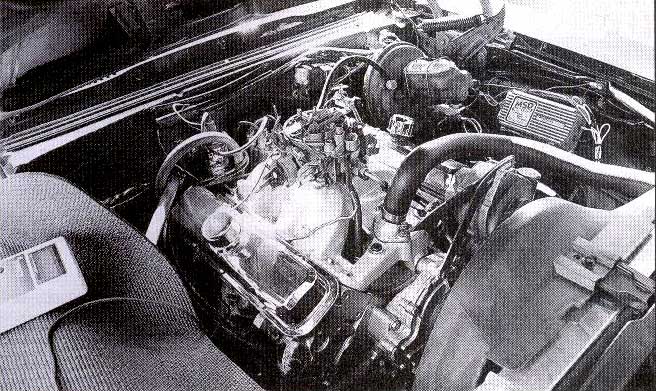
We felt our ’67 Firebird convertible would be an excellent candidate to test the functionality and versatility of the LM-1. Our Firebird features a basic performance rebuild using stock-type parts with part-throttle street manners receiving as much attention as full-throttle performance. The original 400 was removed and replaced with a 455 now displacing 462 ci. It features mildly ported 4X heads with 2.11/1.77 inch valves, a compression ratio just over 9.75:1, a Nunzi hydraulic camshaft with 222/232 degrees duration at .050, an Edelbrock Performer RPM intake manifold, and a ’77 Pontiac 800-cfm Quadrajet. The combination is rounded out with four-tube headers followed by a Flowmaster exhaust system and a Turbo 400 backed by a limited-slip 3.55 rearend. It feels strong under all types of driving conditions, and in many respects it represents a wide variety of combinations seen on the streets today.
Getting Started
Our first step in testing was to connect the LM-1 to a 12-volt power source and calibrate the 02 sensor to open air as stated in the instructions. Once calibrated we inserted the probe into the tailpipe, and with our engine running at normal operating temperature, we viewed the readings. We knew our car was slightly rich at idle by the smell of raw fuel from the exhaust, and our suspicions were confirmed with an A/F ratio of about 13.2:1 at idle. Before making any changes, we took our Firebird for a test drive, noting the A/F ratio under the diferent types of driving conditions it sees and allowing us to accurately view the effects of the changes we might make.
We quickly found our car was running around 12.5:1 under aggressive, part-throttle conditions with a slight cruise ratio near 14:1. We also found our full-throttle A/F ratio to be near 11.5:1, which is a bit rich according to the experienced sources we contacted.
Using the LM-1 as a Tuning Aid
We then directed our attention to the carburetor. Since the Quadrajet has separate primary and secondary circuits, each can be tailored independently to produce the best total performance while on the respective circuit, giving the best overall throttle response in all types of driving conditions. For the most accurate results we opted to tune each circuit independantly, limiting our first changes to the primary side, then addressing the secondary side.
Knowing the A/F ratio was 13.2:1 at idle, we readjusted the idle mixture screws located in front on the base of the Quadrajet. This leaned the idle ratio to around 13.5:1 but had little effect on part-throttle readings. Wanting to lean the part-throttle ratio, we replaced th existing .074-inch primary metering jets with leaner .072 jets. This allowed us to further trim our A/F ratio to around 14.7:1 at idle, and the test drive immediately after proved this was a step in the right direction. Throttle response had noticeably improved and our engine was more sensitive to throttle position changes making the car easier to drive. The LM-1 agreed, now showing our light cruise mixture around 14.5:1 with aggressive part-throttle near 12.8:1.
Since its rebuild our carburetor has been running secondary metering rods with a 0.35-inch tip with satisfying results. With the initial test drive we knew the full-throttle A/F ratio of 11.5 was slightly rich and leaning it might produce a more complete burn. Wanting to place the ratio closer to 12.5 to 13:1, we selected rods with a tip diameter of .044 inch, which leaned the ratio to around 12.2:1. Since we are trying to extract maximum efficiency from our combination and hoping to lean it further, we installed secondary rods with a .0527-inch tip, which improved the full-throttle A/F ratio to 12.7:1 and within our target range. Acceleration felt more brisk, especially at the point the secondary air valve began to open, which are the results we hoped for.
Conclusion
While experienced tuners could achieve similar results with minimal trial and error, the LM-1 gives the backyard mechanic an opportunity to tune his or her Pontiac to perform equally well. To some it may first appear to be a race-only tuning tool, but we quickly saw how beneficial the LM-1 can be for street cars, and having your car perform better under all types of driving conditions is never unpleasant. It might take supertuning your Pontiac to the next level!