Spark Timing Myths Debunked
A widely-held myth is that maximum advance always means maximum power. Here’s what’s wrong with this thinking:
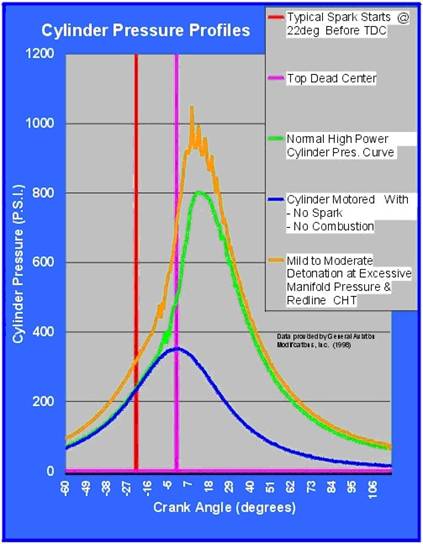
The spark plug ignites the mixture and the fire starts burning. The speed of this flame front depends on the mixture, this means how many air and fuel molecules are packed together in the combustion chamber. The closer they are packed together in the same volume, the easier it is for the fire to jump from one set of molecules to the other. The burning speed is also dependent on the air-fuel-ratio. At about 12.5 to 13 air-fuel-ratio the mixture burns fastest. A leaner mixture than that burns slower. A richer mixture also burns slower. That’s why the maximum power mixture is at the fastest burn speed. It takes some time for this flame front to consume all the fuel in the combustion chamber. As it burns, the pressure and temperature in the cylinder increases. This pressure peaks at some point after TDC. Many experiments have shown that the optimum position for this pressure peak is about 15 to 20 degrees after TDC. The exact location of the optimum pressure peak is actually independent of engine load or RPM, but dependent on engine geometry.
Typically all the mixture is burned before about 70 deg ATDC. But because the mixture density and AFR in the engine change all the time, the fire has to be ignited just at the right time to get the peak pressure at the optimal point. As the engine speed increases, you need to ignite the mixture in the combustion chamber earlier because there is less time between spark and optimum peak pressure angle. If the mixture density is changed due to for example boost or higher compression ratio, the spark has to be ignited later to hit the same optimal point.
If the mixture is ignited to early, the piston is still moving up towards TDC as the pressure from the burning mixture builds. This has several effects:
- The pressure buildup before TDC tries to turn the engine backward, costing power.
- The point where the pressure in the cylinder peaks is much closer to TDC, with the result of less mechanical leverage on the crankshaft (less power) and also causes MUCH higher pressure peaks and temperatures, leading to knock.
Many people with aftermarket turbos don’t change the spark advance very much, believing that earlier spark creates more power. To combat knock they make the mixture richer. All that happens really then is that the mixture burns slower and therefore hits the peak pressure closer to the right point. This of course reaffirms the belief that the richer mixture creates more power. In reality the flame front speed was adjusted to get the right peak pressure point. The same result (with more power, less emissions and less fuel consumption) could be achieved by leaving the mixture at the leaner optimum and retarding the ignition more instead.
Turbo charging or increasing the compression ratio changes the mixture density (more air and fuel molecules are packed together). This increases the peak pressure and temperature. The pressure and temperature can get so high that the remaining unburned mixture ignites by itself at the hottest part in the combustion chamber. This self-ignition happens explosively and is called ‘knock’. All engines knock somewhat. If there is very little unburned mixture remaining when it self-ignites, the explosion of that small amount does not cause any problems because it can’t create a large, sharp pressure peak. Igniting the mixture later (retarding) causes the peak pressure to be much lower and cures the knock.
The advances in power of modern engines, despite the lower quality of gasoline today, comes partially from improvements in combustion chamber and spark plug location. Modern engines are optimized so that the flame front has the least distance to travel and consumes the mixture as fast as possible. An already burned mixture can no longer explode and therefore higher compression ratios are possible with lower octane fuel. Some race or high performance engines actually have 2 or three spark plugs to ignite the mixture from multiple points. This is done so that the actual burn time is faster with multiple flame fronts. Again, this is to consume the mixture faster without giving it a chance to self-ignite.
Higher octane fuel is more resistant to self-ignition. It takes a higher temperature and pressure to cause it to burn by itself. That’s why race fuels are used for engines with high compression or boost. Lead additives have been used, and are still used to raise the self-ignition threshhold of gasoline, but lead is toxic and therefore no longer used for pump-gas. Of course a blown engine is toxic to your wallet.
Klaus Allmendinger is the VP of Engineering for Innovate Motorsports, a division of Innovate! Technology, Inc. Innovate develops digital tools for tuning internal-combustion engines.