
Standalone ECU Tuning
Most modern standalone Engine Control Units can benefit from the use of a wideband Air/Fuel meter. A few of the basic applications are closed-loop EFI operation, tuning and setup, and narrow-band emulation.
Closed-loop EFI operation.In this application, the wideband controller (LM-1, etc.) controls the wideband oxygen sensor, and outputs a 0-5V signal that continuously informs the ECU what the measured air/fuel ratio is. The trick is to match the voltage-to-AFR correlation so that it is mapped correctly to the ECU All Innovate wideband controllers have programmable analog outputs, so often it is as simple as determining what the ECU is looking for, and programming the LM-1 to match it.Innovate digital wideband outputs are truly linear, and many older analog controllers are non-linear, so, in some cases, you’ll need to reprogram the ECU’s input table to match the Innovate output. Here’s an example from an Electromotive Tech-3 ECU (link to Tech-3 App. Note):
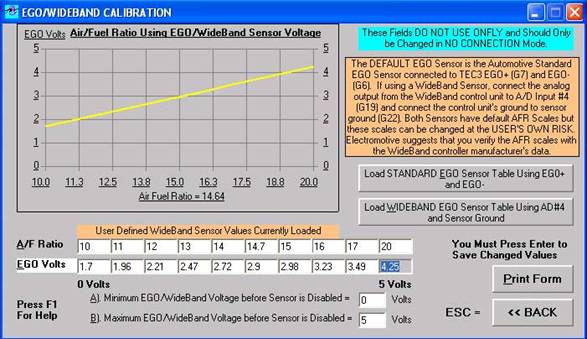
Remember to ground the analog output to the same ground as the ECU to avoid ground offset issues. If you still see ground offset, you can shift the LC-1 or LM-1’s output to compensate. NOTE: Some ECUs will operate in closed-loop mode only at cruise or idle (not at WOT), so check the specs on your ECU.
Basic Tuning. Another common application of tuning a standalone ECU involves utilizing Innovate datalogging capabilities (LM-1, DL-32, or LogWorks direct on a PC). Most ECUs ship with a base fuel map. This map is designed to get the vehicle running safely so that it can then be tuned to optimum. Accordingly, the base map is almost always far from perfect. Often it is way to rich, which means you’re wasting fuel and losing horsepower.The process here is to record a log of AFR and RPM (at least). With LogWorks, you can then graph and chart the actual AFRs, under real road conditions, at every load and RPM. With a chart like this:
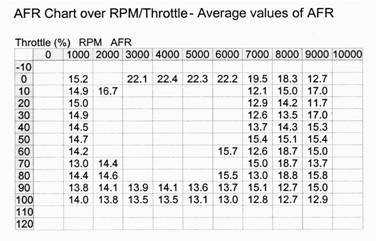
You can make appropriate changes to your ECU’s target fuel map, then repeat the process. By logging other key variables, such as throttle position- TPS, manifold absolute pressure- MAP, cylinder head temperature-CHT, and/or acceleration, you can further understand exactly what’s going on with your engine, and dial in it in for maximum power, maximum efficiency, or the perfect balance.
Narrow-band emulation. In some cases, your ECU might operate best with a narrow-band oxygen sensor input. You can use the LM-1 to provide this also. The factory setting for output #1 is set to emulate the steep and narrow output curve of a stock narrow-band sensor. You can also shift this to trick an ECU into providing more horsepower under some conditions.
Here are links to some of the more popular standalone ECU manufacturers:
034 EFI
Autronic
Electromotive
Haltech
Holley
Hondata
Link ECU
Motec
Pectel Control Systems